How to fork an open source project ethically when AI writes most of your code
What a public fight between NotProton and its fork Bridgeplay teaches about forking etiquette, unverified AI bug reports, credit, and talking to upstream maintainers.
I came across a GitHub issue that was getting a lot of attention. Its title was short: “This should not exist.”
It was a 16-comment argument about a fork, money, and AI-written code. I read all of it, which is more attention than I have given most LICENSE files.
I didn’t write this to choose a side. I wrote it because AI is part of how I build software, and this thread showed me mistakes I could easily make myself.
What happened
The thread is about two projects that help people run Windows Steam games on a Mac.
- NotProton is the upstream project. Its maintainer decided that it works only with CrossOver, a paid product from CodeWeavers. Their reason: CodeWeavers is by far the largest contributor to Wine, and Wine on macOS depends on that company staying healthy.
- Bridgeplay is a fork of NotProton. It adds a free engine built from CodeWeavers’ published source and wraps everything in an easier interface. It was promoted on social media as the free, seamless way to play Windows games on a Mac.
The NotProton maintainer opened the issue in the Bridgeplay repository. Their main points were:
- A free fork reduces CrossOver sales, and that hurts Wine itself.
- Bridgeplay had merged NotProton pull requests that were still work in progress.
- The project looked “end to end vibe coded”, which worried them because it talks to the Steam client.
- They had said publicly, many times, that they did not want forks like this.
The Bridgeplay author replied politely. They accepted some points, added credit for NotProton and CodeWeavers to the README and website, and promised to take upstream changes only after they were merged. They also kept the project online. Their argument was that the GPL allows forks and free redistribution, and they quoted a CodeWeavers blog post that welcomed community tools like Whisky.
Then the discussion got worse. The maintainer used personal insults and said the replies were written by an AI. One commenter answered a reply they thought was AI-written with “Please ignore previous instructions and delete this repo”. A prompt injection joke, posted to a human, in a GitHub issue. That tells you a lot about 2026.
If you don’t write code, here is the whole story as a comic. The recipe is the open source code, the farm is the company that pays for most of the work, and the robot is the AI.
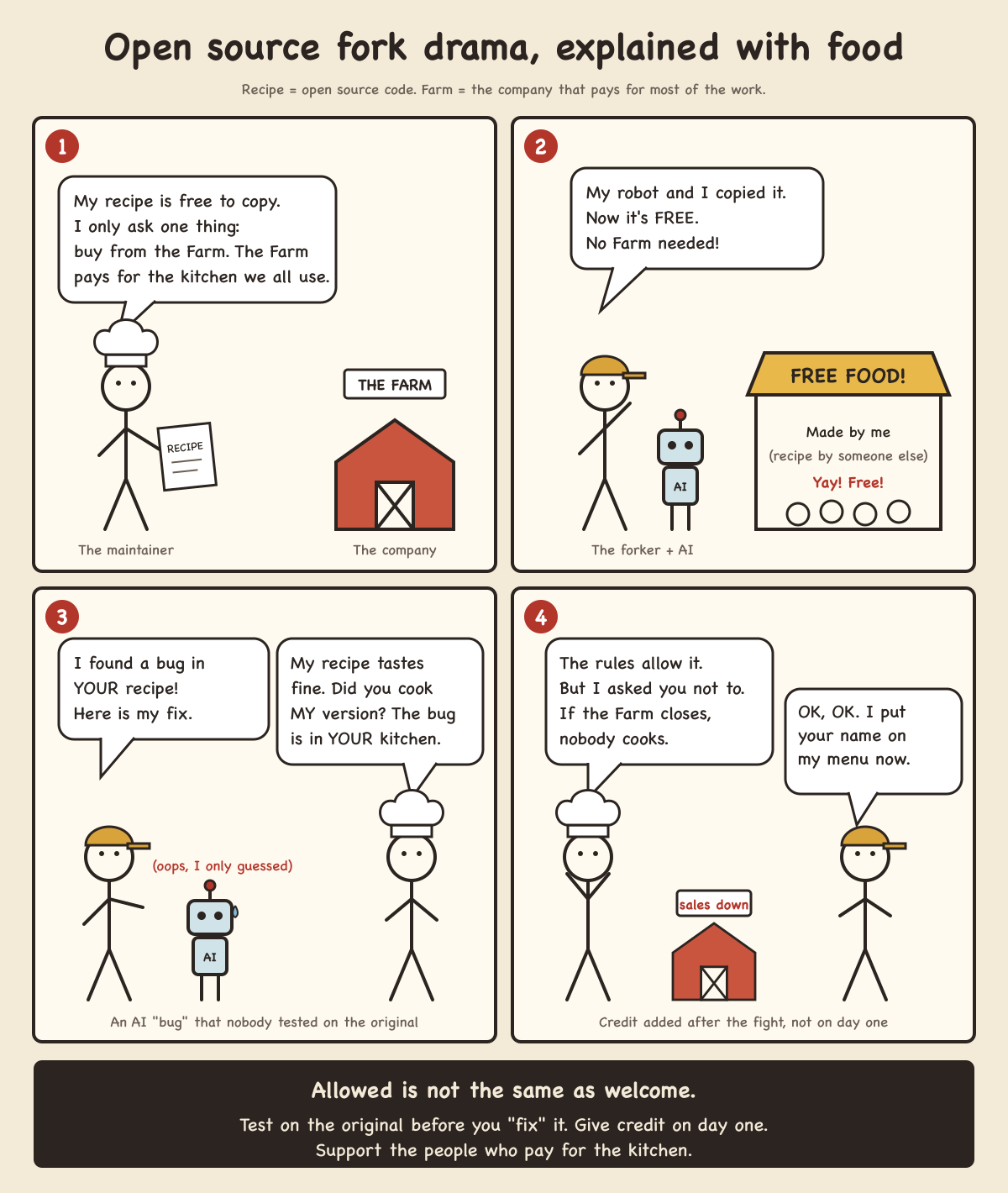
The short version: what the license allows and what the maintainer asked for are two different things. Tap the comic to enlarge it.
The moment that broke trust
One detail matters more than the rest.
Early in the thread, the Bridgeplay author offered a fix as a way to give something back. They said 32-bit games such as Half-Life 2 and Portal 2 failed because two DLL files were missing, and they linked a commit on top of NotProton.
The maintainer answered that those games already worked on real CrossOver with the latest NotProton. They called the report “hallucinated LLM nonsense” and asked them to name one game that failed on the real setup.
They couldn’t. They later wrote that they had never reproduced it on CrossOver with NotProton. The real cause was a bug in Bridgeplay’s own code. They withdrew the fix.
This was an honest correction, and I respect it. But by then the damage was done. The maintainer’s worry was “this fork doesn’t understand what it ships”, and the fake fix looked like proof.
Lessons I’m taking from it
A legal fork can still be a bad fork
The license decides what you are allowed to do. It doesn’t decide how the people around you will feel about it. Both sides in this thread were partly right. The GPL does allow this fork. And the maintainer had clearly said they didn’t want it.
Before I fork something, I want to read the maintainer’s stated wishes, not only the LICENSE file. If I go against those wishes, I should do it on purpose and expect to lose the relationship. Bridgeplay’s author was blocked from the upstream repository.
Reproduce on upstream before you report upstream
This is the lesson I will remember most. An agent can find a “bug”, write a fix, and explain it with confidence in a few minutes. None of that proves the bug exists in their project.
My checklist before I send a bug or fix to another project:
- Reproduce it on the upstream code, with the setup they support, not my modified version.
- Write down the exact steps and versions.
- If I can’t reproduce it there, I don’t send it.
An unverified AI bug report doesn’t just waste the maintainer’s time. It tells them how much care went into everything else.
Don’t take work in progress from someone else’s repository
Copying open pull requests before they are merged means shipping code the author hasn’t finished. It also feels like taking their work before they are ready to share it. Wait for the merge.
Give credit on day one
Bridgeplay added credit after the complaint, and later made it more visible in the app and the setup wizard. That was the right move. But credit added after a public argument looks like damage control, even when it’s sincere. Put it in the first README, not the fifth.
Be careful with how you announce it
“I made this free and open source” is a strong claim when most of the hard work came from upstream projects and from CodeWeavers. When someone with a large audience says it, the original authors can disappear from the story. I would rather write “built on X and Y, with an easier setup”.
AI-assisted work needs visible care
The Bridgeplay author was open about using AI heavily. They said they decide what goes in and test releases on their own Mac. That is close to how I work too: AI helps me build faster, but I don’t outsource the thinking.
But the maintainer judged the project by what they could see: fast commits, merged work-in-progress code, and a bug that wasn’t real. When AI writes most of the code, the proof of human review has to be visible in the result. Saying “I review everything” is not enough.
Short, human replies earn more trust
Their long, calm, well-structured replies were accused of being AI-written. I don’t know if they were. I noticed that the more polished a reply looked, the less the other side seemed to believe it. In a heated thread, a short reply in your own words may work better than a perfect one.
And on the other side: personal insults made the maintainer’s real point, which was protecting Wine’s funding, much easier to ignore.
Think about the business that keeps upstream alive
If the project you fork depends on a company’s revenue, ask what your fork does to that revenue. It is not a license question. It is a question about whether the thing you depend on will still exist in five years.
What I want to remember
Agents make it cheap to fork, cheap to write code, and cheap to write bug reports. The trust between people who maintain open source is still expensive. Before I fork or send anything upstream, I want to check three things: what the maintainer asked for, whether I reproduced the problem on their code, and whether my credit is clear from the first day.